
 Zyntra OS
 Zyntra Legal
 Zyntra Real Estate
 Zyntra Hotel
 Zyntra E-commerce
 Zyntra Appointments
 Zyntra Repair
 Zyntra Garage
 Zyntra Concierge
 Zyntra Contracting
 Zyntra Clinic
 Zyntra Dental
 Zyntra School
 Zyntra University
 Zyntra Call Center
 Zyntra OTA
A business system fails quietly. Nobody announces that it didn't work. The invoices keep going out, but from a spreadsheet. The projects are still tracked, but in a chat group. Six months after launch the software is a place where data is copied to, not the place the work happens. The cause is usually not the software's features. It is that using it correctly required knowledge that only two people ever had.
This article has no statistics in it, on purpose. It is an argument from how this goes in practice.
The training cycle nobody budgets for
Big enterprise systems assume training. That is not a flaw; the systems are genuinely complex, and the complexity buys real capability for companies that need it. But training is not a one-off cost. It repeats.
Someone in accounts leaves. The new person needs the course. A department reorganises and three people inherit screens they have never seen. A busy month arrives and the temporary help gets shown "just the bit you need", which turns into the only bit anyone uses. Each cycle has a cost in time, and a second cost that no one measures: during the gap, people go back to the tool they already understand. That is usually a spreadsheet, and spreadsheets are where systems go to be quietly replaced.
What "easy" means, specifically
"User-friendly" as a marketing word means nothing. As a design property it means a few concrete things:
The screen tells you what you can do here. Not a manual, not a training video. The options available on this screen, visible on this screen.
The system offers what it already knows. If a field wants a customer, the system should offer your customers. If it wants a date, it should offer today, tomorrow and a picker. Every field that asks a person to remember something is a field that will be filled in wrong eventually.
It lets you stop. A ten-step form that only saves at step ten guarantees abandoned work. Being able to finish with what you have, and come back, is the difference between a record that exists and one that doesn't.
It is reversible. People move faster when a mistake is undoable, and slower — or not at all — when it isn't.
The first task is achievable on day one. Not everything. One useful task, without help.
How to test it before you buy
Take the person in your company who is least interested in software. Give them one ordinary task in the demo system: create a customer, raise an invoice, start a project. Do not help them. Watch where they stop.
That five-minute test tells you more than a feature comparison, because features are what a salesperson shows and stopping points are what your team will meet every day. If the vendor will not let you run it, that is an answer too.
The honest trade-off
Simple systems are not always the right choice. A manufacturer with complex compliance requirements may genuinely need a system that takes weeks to learn, and the alternative would be worse. The mistake is not choosing a powerful system. It is choosing one, skipping the training budget, and then wondering why adoption stalled.
What most mid-sized companies need is narrower than what they are sold, and the software that wins is the one that survives the arrival of a new employee in month seven.
Where we stand
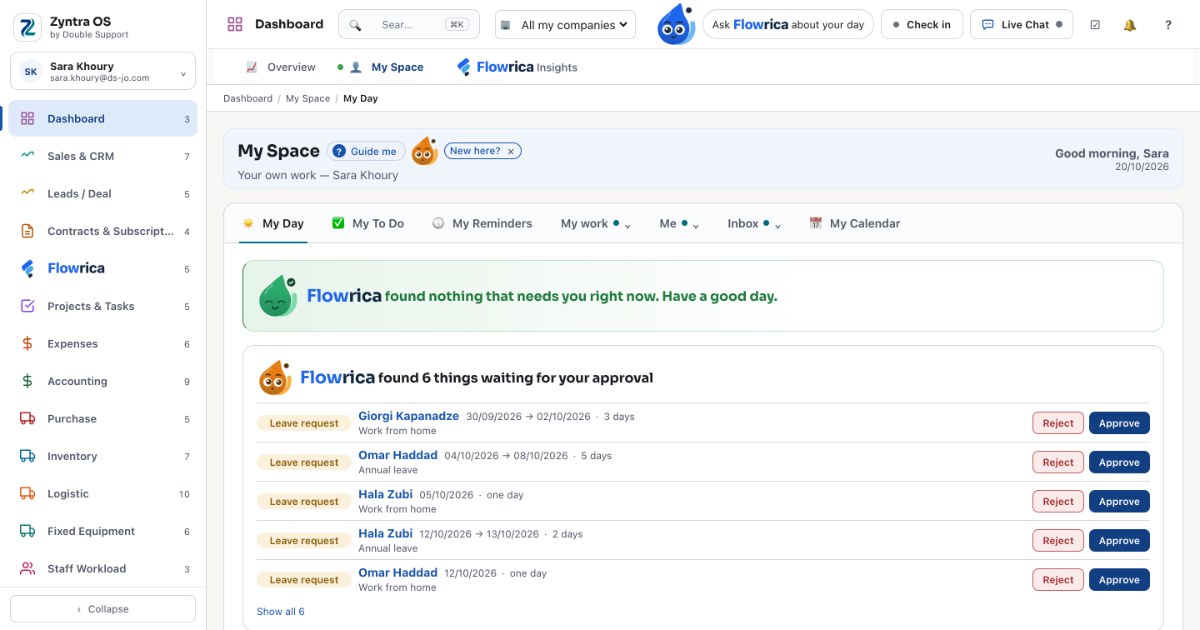
We built our own business system around this. Zyntra OS is designed so that finding your way around works like the apps people already use, and Flowrica — built into it — asks one plain question at a time, offers your own records as the answers, and fills the form for you to save. Someone who has never opened it can get a real task done.
That is the claim we make, and the five-minute test above is a fair way to check it: see how Zyntra OS works.