

 Zyntra OS
 Zyntra Legal
 Zyntra Real Estate
 Zyntra Hotel
 Zyntra E-commerce
 Zyntra Appointments
 Zyntra Repair
 Zyntra Garage
 Zyntra Concierge
 Zyntra Contracting
 Zyntra Clinic
 Zyntra Dental
 Zyntra School
 Zyntra University
 Zyntra Call Center
 Zyntra OTA
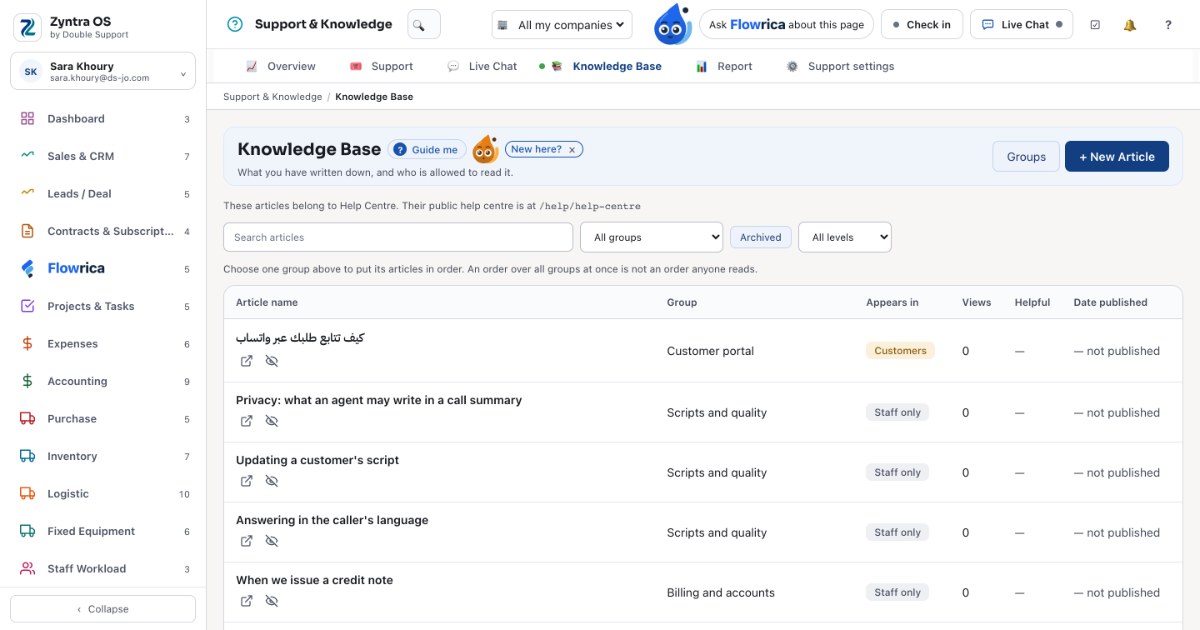
Outsourced support fails in the first fortnight or it doesn't fail at all. The provider is rarely the reason. The reason is that the knowledge which made your in-house team good was never written down, so the new team starts with a phone number, a login and a product they have never used.
This article has no statistics in it. It is an argument from how these moves go.
What your in-house team knows that isn't written anywhere
Ask the person who has answered your customers for two years what they know, and they will say "not much". Then watch them work. They know which three questions make up half the queue. They know the customer who calls every Monday and what he actually wants. They know the bug that support has been working around since spring, and the sentence that calms someone down when it happens.
None of that is in a knowledge base, because nobody writes down the things they find obvious. A handover is the act of making that knowledge explicit, and it takes longer than anyone budgets.
Write these five things down first
The top twenty contact reasons, in order, with the answer to each. Not policies: the actual words that resolve it.
The five that go wrong, with what customers say when they're upset and what they're owed.
Where the boundaries are. What an agent may decide alone: a refund up to a limit, a replacement, an apology credit. Vagueness here produces either paralysis or expensive improvisation.
The escalation path, with names and hours. Who takes the call the agent can't finish, and what happens at 6pm.
The vocabulary. Your product's own names for things. Nothing marks an outsourced agent out faster than calling a feature by the wrong name.
Keep something in-house
Handing over the whole queue on day one is the most common way this goes wrong. Two arrangements work better:
Keep the escalation seat. The outsourced team takes the volume; one person of yours handles the hard end and, more importantly, feeds back what the hard end is teaching them.
Keep the first read on complaints. Complaints are where a brand is decided, and they are the last thing to hand over, if you hand them over at all.
Phase it so customers don't feel it
Week one: the new team listens, reads and answers nothing. Week two: they take the simplest contact type, all of it, with your team reviewing every ticket. Then add a contact type a week, in order of how much judgement it needs. Keep the review going until the score stops surprising you.
Two rules make the phasing work: the outsourced team always has somebody to ask, and no contact type moves until the previous one is steady.
What to measure while it happens
Watch the ratio of contacts resolved without escalation, per contact type. That number tells you whether the handover is working better than any satisfaction score, because it isolates what the new team can actually do.
Watch repeat contacts too: the same customer coming back about the same thing means a resolution that didn't hold.
And read transcripts yourself, at least in the first month. Not as a quality audit. As the fastest way to find out what your own documentation failed to say.
The honest part
A good outsourced team will be as good as your in-house team on routine contacts within a few weeks, and it will take longer than that on judgement calls, because judgement calls run on context that takes months to accumulate. Planning for that — instead of being surprised by it — is most of the difference between a handover that works and one that gets abandoned at week three.
If you're considering it: call center agents.